Clock It Meaning: 30+ Powerful Slang Uses, Positive & Negative Examples
Learn the clock it meaning in slang, texting, and TikTok, with examples, positive and negative uses, gestures, and cultural origins.
Clock it meaning usually refers to noticing something, recognizing a detail, or pointing out something others may have missed. In texting and social media, people use it to highlight a contradiction, agree with an observation, or draw attention to something revealing.
For example, if someone says they don’t care about their ex but checks every new post, a friend might reply, “Clock it!” Depending on the context, the phrase can express humor, praise, or criticism.
However, “clock it” has a cultural history that goes beyond internet slang. Understanding its different uses helps you interpret the phrase correctly and avoid misunderstandings.
Quick Meaning of Clock It
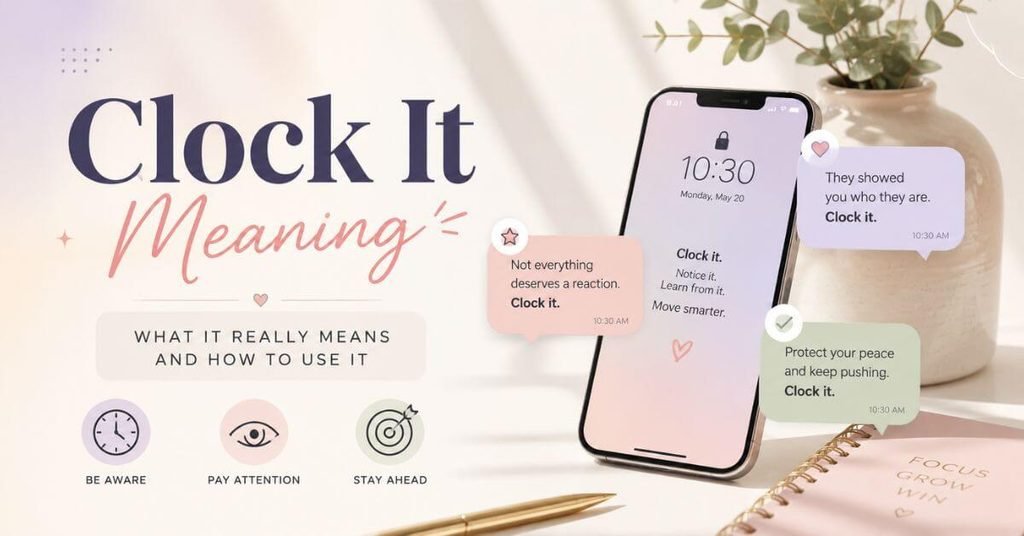
- Simple meaning: Notice something, recognize a detail, or draw attention to a point.
- In slang: It can mean “pay attention,” “you caught that,” or “that’s worth noticing.”
- Example: “He claimed he was busy, but he shared photos from the beach.”
- Tone: It can be funny, approving, neutral, or confrontational.
The easiest way to understand “clock it” is to look at what the speaker wants others to notice.
Clock It Meaning in Slang
In modern slang, clock it often means spotting something that reveals more than someone intended. It can refer to a contradiction, a noticeable behavior, or an observation that others overlooked.
People also say “Clock it!” to agree with someone who has noticed an important detail, such as a clue in a TV show.
The expression isn’t always negative. It can recognize someone’s sharp observation without accusing anyone of wrongdoing.
Clock It Meaning in Texting and Social Media
In text messages, TikTok comments, and Instagram discussions, “clock it” works as a quick reaction to something worth noticing.
- Texting: “You said you were asleep, but you replied to my story. Clock it.”
- TikTok: A commenter might write “Clock it!” after someone points out a contradiction in a video.
- Instagram: Someone may use the phrase to highlight a detail in a celebrity’s outfit or caption.
- Group chats: Friends might use it to tease each other about an obvious crush or a funny habit.
“Clocked it” is another common form. If someone says, “You clocked it,” they usually mean you noticed something correctly.
The meaning depends on context. A laughing emoji may make the phrase playful, while a serious comment can make it sound critical.
Different Meanings of Clock It
The phrase can communicate several related ideas:
- Notice a detail: “Did you clock the matching shoes?” means “Did you notice them?”
- Point out an inconsistency: “He claimed he wasn’t there, but he appears in the photo. Clock it.”
- Recognize a good observation: “You clocked it before anyone else.”
- Highlight the behavior: “Clock how she switched the topic.”
- Literal timing: In a different context, “clock” can mean measuring or recording time, such as timing an athlete’s run.
| Meaning | Example |
| Notice something | “Clock the new haircut!” |
| Point out a contradiction | “His story keeps changing. Clock it.” |
| Agree with an observation | “Clock it! That’s exactly what happened.” |
| Record a time | “The coach clocked her lap.” |
The surrounding sentence usually makes the intended meaning clear.
Positive, Neutral, and Negative Uses
Positive: “You clocked the clue before everyone else!” It compliments someone for spotting a key detail.
Neutral: “Clock the sign near the entrance.” Here, the speaker simply asks someone to notice something.
Negative example: “He claims to value honesty, yet he keeps lying. Clock it.” The phrase draws attention to behavior the speaker considers dishonest.
Playful: Friends might say “Clock it” when teasing each other about a crush or a familiar habit.
Before using the phrase, consider your audience. A joke between close friends may feel embarrassing or insulting when directed at someone who doesn’t share the same sense of humor.
Clock It Examples in Everyday Conversations
These examples show how the phrase works in different situations.
- Between friends: “You said you couldn’t stand that song, but you’ve played it five times today. Clock it!” The speaker points out an amusing contradiction.
- Dating example: “He says he’s too busy to text, yet he’s online all day. Notice the contradiction.”
- At work: “The totals don’t match the listed prices.” “Good catch—you clocked it.” Here, the phrase recognizes an accurate observation.
- On social media: “Notice how the caption changed after people questioned the story. Clock it.” The commenter highlights the timing.
- Watching a show: “I clocked the villain’s reaction in the first episode.” The speaker noticed a clue early.
These examples show that “clock it” can express anything from lighthearted recognition to pointed criticism.
Clock It vs. Clocked It
The difference usually comes down to how the phrase is used in a sentence.
- Clock it: Directs attention toward something. Example: “Clock it—he avoided the question.”
- Clocked it: Describes something already noticed. Example: “I clocked it yesterday.”
- You clocked it: Often praises someone for recognizing a detail. Example: “You clocked it before I did!”
Casual slang doesn’t always follow strict rules, so context still matters.
Clock It vs. Call It Out
Both expressions can draw attention to behavior, but they aren’t quite the same.
- Clock it often emphasizes noticing or recognizing something. “Clock how he keeps switching topics” points out a repeated behavior.
- Calling it out more directly means challenging or criticizing an action. “I confronted him about changing his story” describes directly challenging someone’s inconsistency.
Someone can clock a problem without confronting the person responsible. Calling it out usually involves making the problem more explicit.
Pros and Cons of Clock It Meaning
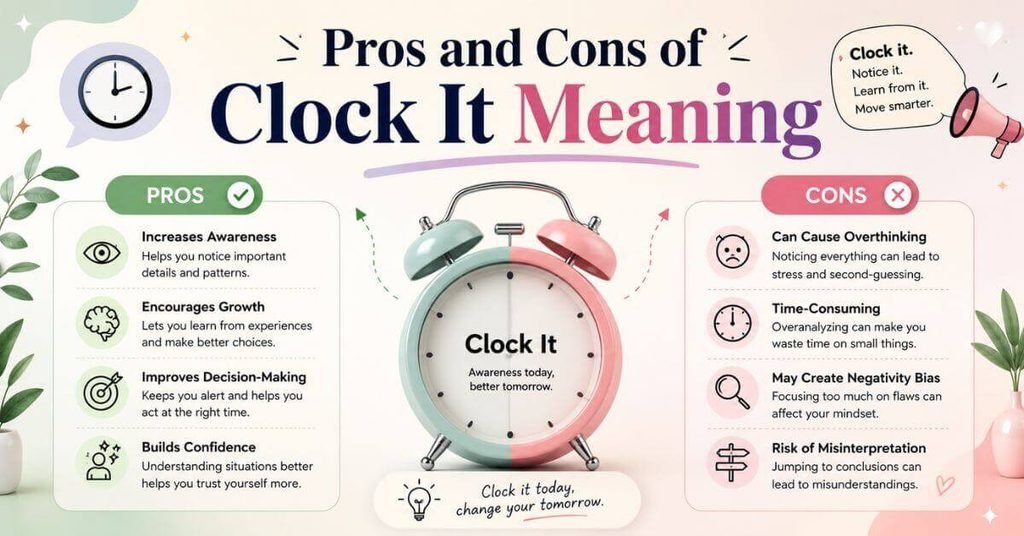
- Pros: The phrase is short, expressive, and useful for acknowledging a clever observation.
- Pros: It can add humor or show agreement in casual conversations.
- Cons: People unfamiliar with the slang may misunderstand it.
- Cons: It can sound sarcastic or judgmental when used to embarrass someone.
- Cons: It may be inappropriate when the observation concerns someone’s private or sensitive information.
Use it when the meaning fits the situation. In formal emails or professional conversations, phrases such as “I noticed that” or “Good catch” may communicate your point more clearly.
Clock It Meaning in LGBTQ+ and Ballroom Culture
“Clock it” has longstanding associations with LGBTQ+ and ballroom culture, particularly communities shaped by Black and Latinx queer and trans people in New York City.
In some of these contexts, clocking can mean noticing or identifying a detail about someone that they may not want others to recognize. The meaning becomes especially sensitive when someone is “clocked” as transgender without choosing to disclose that information.
This differs from the everyday online use of “clock it” to point out a funny contradiction. Unwanted identification can invade someone’s privacy or expose them to discrimination.
Clock It Origin and Cultural History
The verb “clock” has older informal meanings associated with noticing or identifying something. The modern catchphrase is strongly associated with drag and ballroom culture, where words can carry meanings shaped by community and performance.
Social media, entertainment, and reality television have helped bring ballroom-associated expressions into everyday online conversations. TikTok contributed to the phrase’s wider visibility, but that doesn’t mean the platform invented it.
There isn’t a reliably established single inventor or exact first-use date for the modern expression. It’s more accurate to acknowledge its cultural associations than to assign its origin to one person without evidence.
Clock It 🤏 Meaning and Hand Gesture
The 🤏 emoji sometimes appears alongside “clock it” to emphasize an observation or reaction.
A finger-clap associated with ballroom culture involves tapping a finger against the thumb. Online, “Clock it 🤏” may communicate “notice that,” “exactly,” or “you caught the point.”
For example: “He said he didn’t care, but he brought it up three times. Clock it 🤏.”
The emoji doesn’t have one universal slang meaning. Its interpretation depends on the conversation, and the gesture has cultural associations beyond its use in social media comments.
Clock It Meaning in Traditional English
Outside modern slang, “clock” has several established uses:
- Recording time: “The coach clocked her running time.”
- Workplace timekeeping: “I must clock in before my shift begins.”
- Noticing something: “I clocked him leaving the building.”
These meanings help explain why the word appears in different contexts. If someone writes “Clock it!” under a TikTok video, they probably mean “notice that,” not “check the time.”
When someone notices something and emphasizes that it is true, the expression can connect naturally to no cap meaning in text, a slang phrase used to express honesty or seriousness.
Similar Slang Words and Expressions
- Caught that: Means you noticed or understood something.
- Good catch: Praises someone for spotting a detail or mistake.
- Call it out: Means openly highlighting or challenging behavior.
- Read someone: Often means making a sharp or witty observation about someone.
- Spill the tea: Means sharing gossip or interesting information.
- You nailed it: Means someone got a point or answer right.
These expressions aren’t exact synonyms. Choose one that matches your meaning and the tone you want.
Common Misunderstandings About Clock It
- It always means checking the time. In slang, it usually means noticing something or pointing it out.
- It is only Gen Z slang. Its cultural associations predate its recent popularity online.
- It is always an insult. It can be playful, approving, neutral, or critical.
- It means the same as “call it out.” The phrases overlap, but calling something out more directly suggests confrontation.
- The 🤏 emoji defines the phrase. The emoji may add emphasis, but context determines the meaning.
- Its cultural background doesn’t matter. Some uses have sensitive implications, particularly when they involve someone’s gender identity or private information.
The phrase “clock it” can be used to point out a detail someone noticed, much like the expression ate and left no crumbs, which praises someone for doing something exceptionally well.
Frequently Asked Questions
What does “clock it” mean in slang?
It usually means notice something, recognize a detail, or draw attention to something others may have missed.
What does “clock it” mean in texting?
It often means “notice that” or “you caught it.” People use it to react to observations or contradictions.
Is “clock it” positive or negative?
It can be either. The phrase may praise someone’s observation, make a neutral point, or criticize behavior.
What does “clock it” mean on TikTok?
It commonly appears in comments and reaction videos to highlight a revealing detail or agree with an observation.
Is “clock it” rude?
Not necessarily. It can be playful among friends, but it may sound confrontational or invasive in sensitive situations.
Conclusion
The meaning of ” clock it “ is usually to notice something, recognize a detail, or point out what others may have missed. In texting and social media, it can express agreement, humor, or criticism. Context makes the difference. Understanding the phrase’s everyday uses and LGBTQ+ and ballroom-culture associations helps you interpret it more accurately and use it thoughtfully.