
IMO Meaning In Text: 15+ Essential Meanings & Hidden Mistakes
Discover the IMO Meaning in Text, hidden meanings, real examples, uses, replies, mistakes, and a social media guide for 2026.
IMO meaning in text is one of the most searched texting abbreviations today, and for good reason — it shows up constantly in group chats, comments, and DMs, leaving many readers unsure what it actually stands for.
If you’ve paused mid-conversation wondering what someone meant by “IMO,” you’re far from alone, since digital shorthand like this has become second nature to frequent texters but still confuses newer users.
This guide covers exactly what you came looking for: a clear definition of IMO, the reasoning behind why people use it so often, and practical examples of how it appears across everyday texting and social platforms.
By the end, you’ll know not just what IMO means, but when it’s appropriate to use, how its tone can shift, and how it compares to similar abbreviations like IMHO and TBH.
IMO Meaning in Text (Quick Answer)
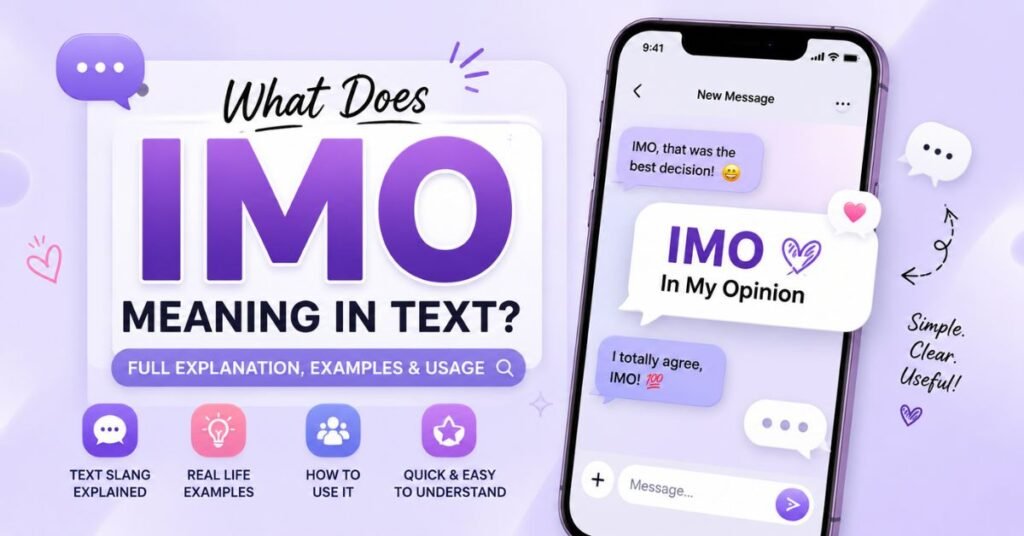
IMO stands for “In My Opinion.” People use it to share a personal view without presenting it as a fact, which keeps conversations friendlier and more respectful. It’s one of the most common texting abbreviations because it’s short, clear, and widely recognized.
- IMO = In My Opinion
- Signals a personal view, not a stated fact
- Common in casual texts, chats, and social posts
- Helps soften disagreements
Examples:
- “IMO, this movie is worth watching.”
- “That phone is better, IMO.”
- “IMO, summer is the best season.”
What Does IMO Really Mean?
IMO always means “In My Opinion,” but its tone shifts depending on the sentence around it. A kind message invites respectful disagreement, while a harsh one stays harsh even with IMO attached. Here’s how the tone can vary by context.
Positive tone
- Shows respect for differing opinions
- Supports polite, open conversation
- Softens advice so it doesn’t sound bossy
Neutral tone
- Simply introduces a viewpoint
- Keeps the conversation balanced
- Adds no extra emotion either way
Negative tone
- Can come across as sarcastic
- May feel passive-aggressive in the wrong context
- Doesn’t excuse rude wording — the words after IMO still matter
Why Do People Use IMO in Text Messages?
People use IMO to express a view without sounding like they’re forcing it on someone else. It signals “this is just my take,” which makes disagreement easier to handle and helps reduce conflict online.
- To share opinions politely
- To avoid unnecessary arguments
- To sound respectful rather than demanding
- To offer friendly advice
- To keep chats feeling natural and casual
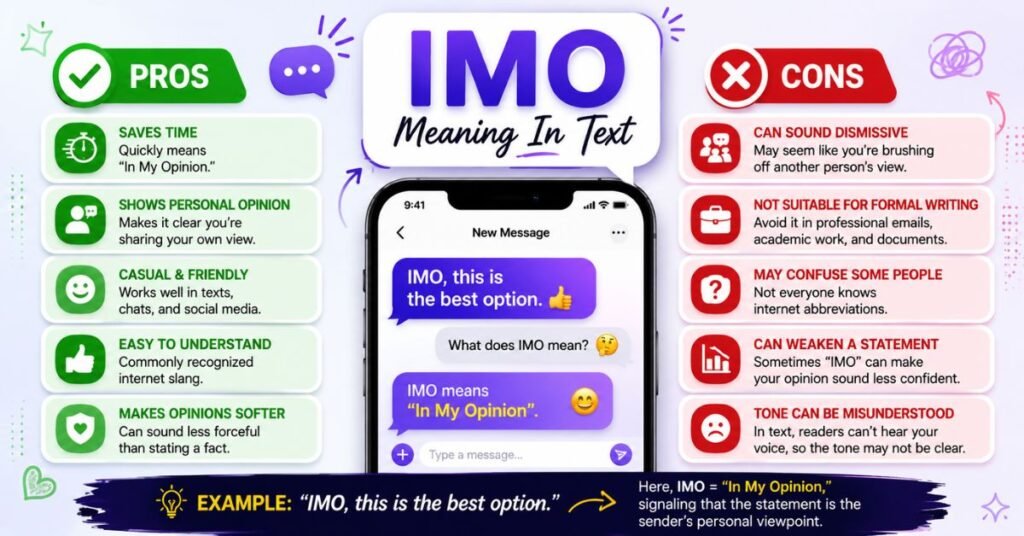
Pros of Using IMO
Used well, IMO makes everyday texting smoother and less confrontational. It fits naturally into informal chats, group texts, and social comments.
- Sounds polite and non-demanding
- Softens strong opinions
- Encourages open discussion
- Saves time while typing
- Widely recognized in modern texting
Cons of Using IMO
IMO isn’t a fix-all. It has real limits, especially outside casual conversation.
- Can confuse people unfamiliar with the abbreviation
- Doesn’t belong in formal or professional writing
- Meaning can shift depending on context
- May read as sarcastic if the tone is off
- Not universally understood across all age groups
How IMO Is Used in Different Situations
The way IMO lands depends on who you’re talking to. It works well in relaxed, informal settings, but it’s best avoided in formal writing where a fully spelled-out opinion reads more professionally.
- Friends: “IMO, that game is really fun.”
- Family: “IMO, we should leave earlier.”
- Dating: “IMO, honesty matters most.”
- School: “IMO, this answer makes more sense.”
- Workplace chats: “IMO, this option is the most practical.”
- Gaming: “IMO, this character is stronger.”
- Online forums: “IMO, this guide is helpful.”
IMO Meaning Across Social Media Platforms
IMO shows up almost everywhere online, from comments to captions to group chats. The meaning doesn’t change platform to platform, but how it’s used can shift with each app’s tone.
- WhatsApp — daily chats
- Snapchat — quick replies
- Instagram — comments under photos
- TikTok — video comments
- Facebook — group discussions
- X (Twitter) — quick opinions
- Reddit — community threads
- Discord — gaming conversations
Real-Life Examples of IMO in Conversations
Seeing IMO in real conversations makes its purpose easier to understand. It usually appears right before or after an opinion, signaling that the statement is personal rather than factual.
- Friend: “IMO, that’s the best movie I’ve seen this year.”
- Coworker: “IMO, we should finish this task today.”
- Student: “IMO, this option is the most practical.”
- Social media: “IMO, this update is much better.”
- Gaming chat: “IMO, this loadout works the best.”
IMO vs IMHO vs TBH vs FWIW
Several texting abbreviations look similar but serve different purposes. Knowing the difference helps you pick the right one and avoid mixed signals in conversation.
| Term | Full Form | Best Used For | Tone |
| IMO | In My Opinion | Sharing an opinion | Neutral |
| IMHO | In My Humble Opinion | Gentle disagreement | Very polite |
| TBH | To Be Honest | Honest thoughts | Direct |
| FWIW | For What It’s Worth | Giving advice | Respectful |
Quick tips:
- Use IMO for everyday opinions
- Use IMHO to sound more humble
- Use TBH when being straightforwardly honest
- Use FWIW when offering a suggestion
If you’re learning common texting abbreviations, you may also want to read our guide on IDC meaning in text to understand how it differs from IMO and when each expression is appropriate.
Other Meanings of IMO
While “In My Opinion” is by far the most common meaning, IMO can stand for other things depending on where you see it. Context is the best clue to figuring out which meaning applies.
- In My Opinion (most common, used in texting)
- I’m Online (casual chats)
- International Maritime Organization (shipping industry)
- IMO messaging app (app-specific discussions)
| Meaning | Where It’s Used |
| In My Opinion | Texting and social media |
| I’m Online | Casual chats |
| International Maritime Organization | Shipping and maritime industry |
| IMO App | Messaging app discussions |
Common IMO Mistakes, Misunderstandings & When to Avoid It
Many people add IMO thinking it automatically makes a message polite. In reality, the words around it still shape how the message feels.
- Using IMO in formal reports or emails
- Confusing IMO with IMHO
- Treating a stated opinion as if it were a fact
- Assuming everyone knows what the abbreviation means
- Keeping a rude tone and expecting IMO to soften it
Who Uses IMO the Most? (Culture & Trends)
IMO is used across age groups, but it’s especially common among younger, digitally native users who rely on short abbreviations to communicate quickly.
- Gen Z users
- Millennials
- Students
- Gamers
- Social media users
- Online community and forum members
How to Reply When Someone Says IMO
When someone uses IMO, they’re sharing a personal take, not stating a fact — so a thoughtful reply keeps the conversation friendly, even if you disagree.
- “I understand your point.”
- “That’s a fair opinion.”
- “I see it differently.”
- “Thanks for sharing.”
- “I respect your opinion.”
Social media is full of abbreviations besides IMO. If you’ve recently seen WTW in chats or comments, check out our complete guide on what WTW means in text to learn its meaning and how people use it in everyday conversations.
Frequently Asked Questions
What does IMO mean in text?
IMO stands for “In My Opinion.” People add it before or after a statement to make clear they’re sharing a personal view, not stating a proven fact. It’s one of the most widely used abbreviations in everyday texting and social media.
Is IMO rude?
No, IMO itself is a polite, neutral phrase. However, the words that follow it still shape the tone of the message. A harsh sentence stays harsh even with IMO attached, so the abbreviation alone can’t fix a rude tone.
What’s the difference between IMO and IMHO?
IMO means “In My Opinion,” while IMHO means “In My Humble Opinion.” Both share an opinion, but IMHO sounds slightly softer and more deferential. Many people use them interchangeably, though IMHO fits gentler disagreements better.
Can IMO mean something else?
Yes, depending on the context. Outside of texting, it can stand for “I’m Online,” the International Maritime Organization, or the IMO messaging app. Reading the surrounding conversation usually makes the intended meaning clear.
Can I use IMO at work?
IMO works fine in casual team chats, quick Slack messages, or informal group threads. It’s best avoided, though, in formal emails, official reports, or client-facing documents, where spelling out your opinion looks more professional.
Final Thoughts
Now that you know what IMO means in text, you can use it confidently to share opinions, give advice, and join conversations without sounding forceful. It remains one of the most widely used abbreviations in modern texting culture.
Whenever you come across IMO, focus on more than just the word itself — consider the tone, the context, and the relationship with the other person. That’s the real key to understanding the message behind it.
One Comment