
NGL Meaning in Text: 20+ Powerful Ways to Understand the Hidden Tone
NGL meaning in text explained with examples, tone, dating context, replies, NGL vs TBH, and when to use or avoid it.
NGL meaning in text is Not Gonna Lie, a casual abbreviation people use before sharing an honest opinion, reaction, feeling, or admission. If someone writes “NGL, I love this,” they are signaling that what follows is their genuine reaction.
You may see NGL in text messages, WhatsApp chats, Instagram DMs, TikTok comments, group chats, and other informal conversations. It can introduce something positive, negative, funny, emotional, surprising, or even slightly awkward.
The important part is that NGL itself does not tell you whether the message is good, bad, serious, or flirty. You need to read the rest of the sentence and consider the relationship and situation.
For example, “NGL, you look great” and “NGL, that was disappointing” use the same abbreviation but communicate very different feelings. Below, you’ll see how people actually use NGL and how to understand it without reading too much into it.
What NGL Means in a Text Message
- NGL stands for Not Gonna Lie, which is a shortened way to introduce an honest statement.
- People mainly use it in casual communication because it sounds conversational rather than formal.
- In texting, NGL often means I’m going to tell you what I really think or feel.
- It can introduce an opinion, personal feeling, compliment, criticism, admission, or immediate reaction.
- The abbreviation does not guarantee that the statement is objectively true; it simply frames it as the speaker’s candid view.
- Lowercase ngl and uppercase NGL generally carry the same meaning in casual digital communication.
Takeaway: NGL is best understood as a conversational signal that prepares you for a candid statement.
Why People Put NGL Before a Sentence
- People use NGL to make an opinion sound more direct and personal.
- It can make a compliment sound more natural and spontaneous rather than carefully planned.
- It can soften a blunt opinion by showing that the person is simply being honest.
- NGL can introduce something the speaker feels slightly embarrassed or vulnerable about.
- It can add emphasis when someone has a strong reaction to something.
- In casual conversations, it often makes the message sound more natural and relaxed.
Tip: Pay attention to the words after NGL because they explain what the person actually wants to communicate.
NGL Can Change Meaning With the Sentence That Follows
- Before a compliment: “NGL, this outfit looks amazing” usually introduces genuine praise.
- Before criticism: “NGL, that movie was boring” signals a straightforward negative opinion.
- Before a personal feeling: “NGL, I miss you” reveals a personal or emotional thought.
- Before an admission: “NGL, you were right” shows that the speaker is admitting something.
- Before surprise: “NGL, I didn’t expect that” highlights an unexpected reaction.
- Before an opinion: “NGL, I think this is the better choice” presents a personal judgment.
Takeaway: The phrase after NGL carries the real message, so never interpret the abbreviation separately from the sentence.
NGL at the Beginning vs. End of a Text
- NGL, I like it because it puts the honesty signal before the speaker gives their opinion.
- I like it; ngl adds the same idea afterward as a casual confirmation.
- NGL at the beginning can make the upcoming statement feel more deliberate or emphasized.
- NGL at the end often feels more relaxed, like an afterthought added to reinforce sincerity.
- The placement normally changes the emphasis, not the basic meaning of the abbreviation.
- Both forms are common in informal texting and social media conversations.
| Placement | Example | Common effect |
| Beginning | NGL, I like it. | Signals honesty before the opinion |
| End | I like it, ngl. | Adds casual emphasis afterward |
Tip: If NGL appears at the end, don’t assume it has a secret meaning; it usually still means Not Gonna Lie.
Is NGL Positive, Negative, Rude, or Flirty?
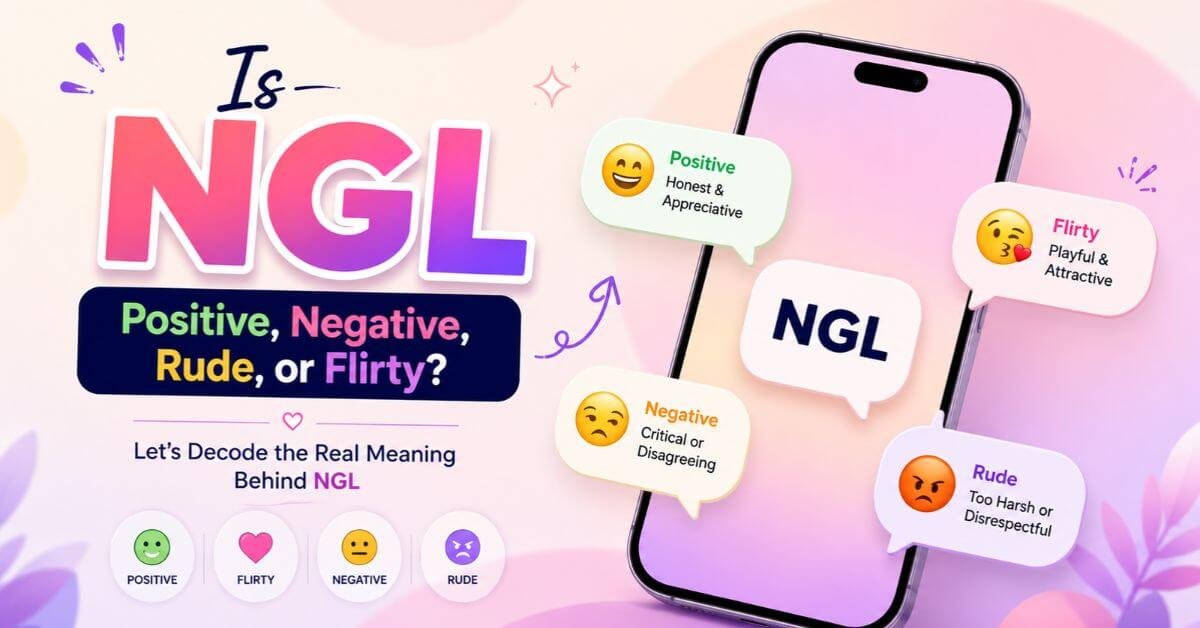
- NGL can have a positive tone when it introduces praise, excitement, appreciation, or a genuine compliment.
- It can be negative when someone is about to criticize something or express disappointment.
- It can sound rude when the statement that follows is unnecessarily harsh or insensitive.
- It can sound sarcastic when the surrounding conversation already has a joking or mocking tone.
- NGL can feel flirty when it appears with romantic compliments or personal feelings.
- It can also be completely neutral when someone simply shares an ordinary opinion.
Insight: NGL does not create the tone by itself; the surrounding words, relationship, and situation determine how it feels.
What NGL Means in Dating, DMs, and Personal Conversations
- In dating conversations, NGL can introduce a compliment such as “NGL, you’re really cute.”
- “NGL, I miss talking to you” can sound emotional, but the relationship gives the statement its deeper meaning.
- When someone uses NGL before a personal admission, it can make the message feel more open or vulnerable.
- NGL from a girl or guy does not have a different dictionary meaning; the actual statement matters more than gender.
- On dating apps, NGL can make a compliment or opinion sound more spontaneous and conversational.
Takeaway: If you’re wondering whether NGL is flirty, read the complete message and consider the relationship instead of treating NGL as proof of attraction.
How NGL Is Used Across Texting and Social Platforms
- In WhatsApp messages, NGL is often used before personal opinions, reactions, or casual admissions.
- In Instagram DMs, people may use it before compliments, opinions, jokes, or personal comments.
- In TikTok comments, NGL can introduce a quick reaction to a video or trend.
- In group chats, it often appears before humorous reactions, agreement, criticism, or surprise.
- In gaming chats, it can introduce a quick opinion about a match, player, strategy, or result.
Tip: The platform usually doesn’t change what NGL means; it mainly changes the context in which the slang appears.
NGL vs TBH, FR, and Other Similar Slang
| Slang | Main idea | How it differs from NGL |
| NGL | Not Gonna Lie | Frames a candid statement |
| TBH | To Be Honest | Very similar honesty signal |
| FR | For Real | Often emphasizes sincerity or agreement |
| IMO | In My Opinion | Clearly marks something as an opinion |
| No cap | No lie / genuinely | Strongly emphasizes that something is not exaggerated |
- NGL and TBH can often work in similar sentences, but their tone can vary slightly depending on context.
- FR is often used to confirm or emphasize something rather than introduce a personal admission.
- IMO specifically identifies an opinion, while NGL can introduce feelings, reactions, or admissions too.
- No cap focuses strongly on genuineness and avoiding exaggeration.
- LOL is different because it expresses laughter rather than emphasizing sincerity.
Insight: Similar texting expressions overlap, but they do not always perform exactly the same job in a sentence.
How to Use NGL Naturally in Texting
- Use NGL before sharing an honest opinion when you want to keep your message casual and straightforward.
- Try “NGL, this is better than I expected” when expressing a positive surprise.
- Use “I didn’t like it, ngl” when adding a casual honesty signal after your opinion.
- Avoid placing NGL before every statement because repeated use can sound forced.
- Keep it mainly for informal conversations, social media, DMs, and casual chats.
Tip: Natural use is simple: say NGL when you want to frame the next thought as your candid reaction or opinion.
When You Should Avoid Using NGL
- NGL is usually not appropriate for formal academic writing or essays.
- A job application should use clear professional language instead of casual texting slang.
- Official documents and business reports should avoid unexplained internet abbreviations.
- Informal workplace chats can be different if casual slang is already normal among the team.
- When clarity is especially important, writing the full thought can be better than using NGL.
Takeaway: NGL is not wrong; it is simply better suited to informal communication than formal writing.
NGL is often used alongside other casual expressions when people want to make a reaction or opinion sound genuine. If you’re comparing similar texting slang, FR in text has a slightly different function because it is more about emphasis or agreement.
NGL Slang vs. the NGL App
- In texting, NGL means Not Gonna Lie and works as an internet abbreviation.
- The NGL app is a separate reference associated with anonymous messaging.
- If NGL appears inside a sentence such as “NGL, I love this,” it is being used as slang.
- If someone discusses anonymous questions, messages, or an app, they may be referring to the NGL app.
- These two uses share the same letters but refer to different things.
Tip: Look at the words around NGL before deciding whether someone means the slang expression or the app.
How to Respond When Someone Says NGL
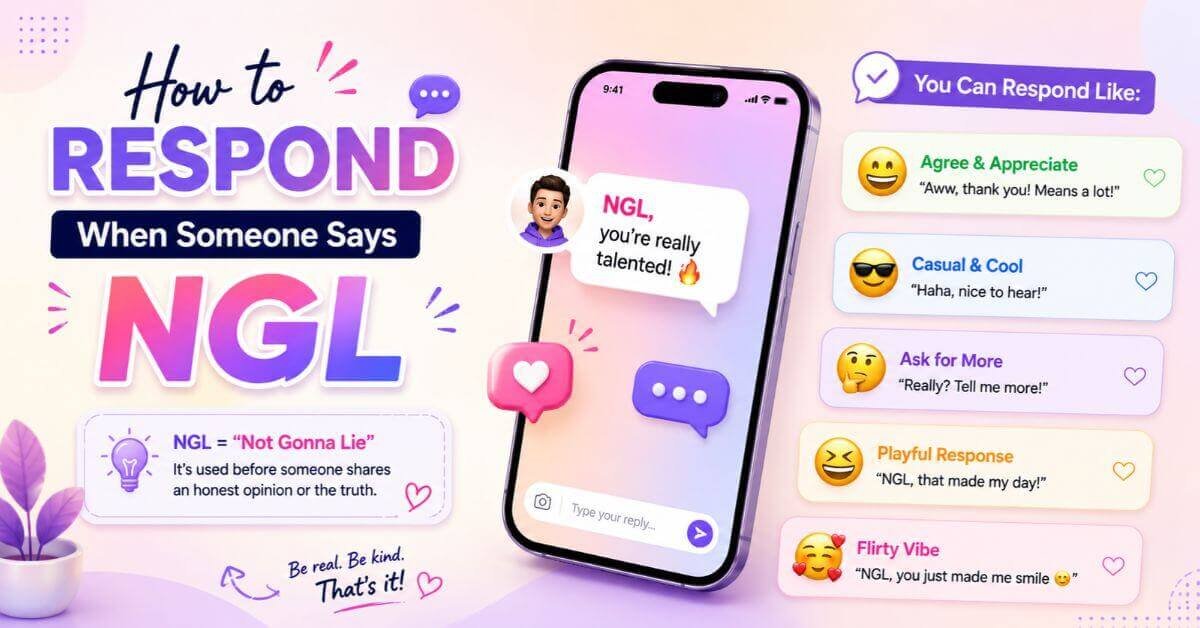
- If someone texts, “NGL, you look great,” you can simply reply, “Thank you!”
- If they share criticism, respond to the actual opinion instead of focusing on the abbreviation.
- If someone says “NGL, I miss you,” your response can depend on how you feel about them.
- For a funny statement, a playful reply can keep the conversation relaxed.
- You do not need a special phrase just because someone used NGL.
Takeaway: Respond to the feeling, opinion, compliment, or criticism that comes after NGL—not to NGL itself.
Common Misunderstandings About NGL
- NGL does not prove that someone is telling an objective truth; it signals their stated honesty.
- NGL does not always introduce something negative or critical.
- NGL is not automatically rude simply because someone uses it before an opinion.
- NGL isn’t necessarily flirty in personal conversations.
- NGL is not the same as LOL because the two abbreviations serve completely different purposes.
Insight: Most misunderstandings happen when people assign extra meaning to NGL instead of looking at the complete message.
My Experience With NGL in Text Conversations
When I come across NGL meaning in text, the easiest way to understand it is to read the sentence as a whole rather than focusing only on the abbreviation. I have found that the same NGL can introduce a compliment in one conversation and criticism in another. The relationship between the people also matters, especially in personal or dating conversations. A short message such as “NGL, I miss you” carries a very different feeling from “NGL, that movie was terrible.” That is why I prefer looking at the words, tone, and situation together before deciding what the sender means.
NGL can introduce an opinion, but it does not specifically mean “in my opinion.” If you want to understand another abbreviation that directly marks a personal opinion, IMO, meaning in text has a different role in texting.
Frequently Asked Questions
What does NGL mean in texting?
NGL means Not Gonna Lie. People use it in casual texts and online conversations before sharing an honest opinion, reaction, feeling, or admission.
Is NGL the same as TBH?
They are very similar because both can introduce an honest statement. However, NGL can feel especially conversational and can introduce reactions or personal feelings as well as opinions.
Is NGL positive or negative?
It can be either. NGL is neutral by itself; the statement that follows determines whether the message sounds positive, negative, funny, emotional, or critical.
Is NGL rude or flirty?
Not automatically. NGL can sound rude or flirty depending on the words around it, the relationship between the people, and the overall tone of the conversation.
Can NGL be used at the end of a sentence?
Yes. For example, “I really enjoyed that, ngl” is a natural casual use. Putting NGL at the end usually adds a relaxed emphasis to the statement.
Wrapping up
In texting, NGL is short for “Not Gonna Lie.” Its real meaning in a conversation depends on what comes after the abbreviation. It can introduce an opinion, compliment, criticism, feeling, confession, or reaction. NGL can be positive, negative, funny, serious, or flirty depending on the context. The best way to understand it is to read the complete message rather than assigning a hidden meaning to NGL alone. For casual texting, DMs, comments, and group chats, it remains a useful way to introduce a candid thought.
One Comment